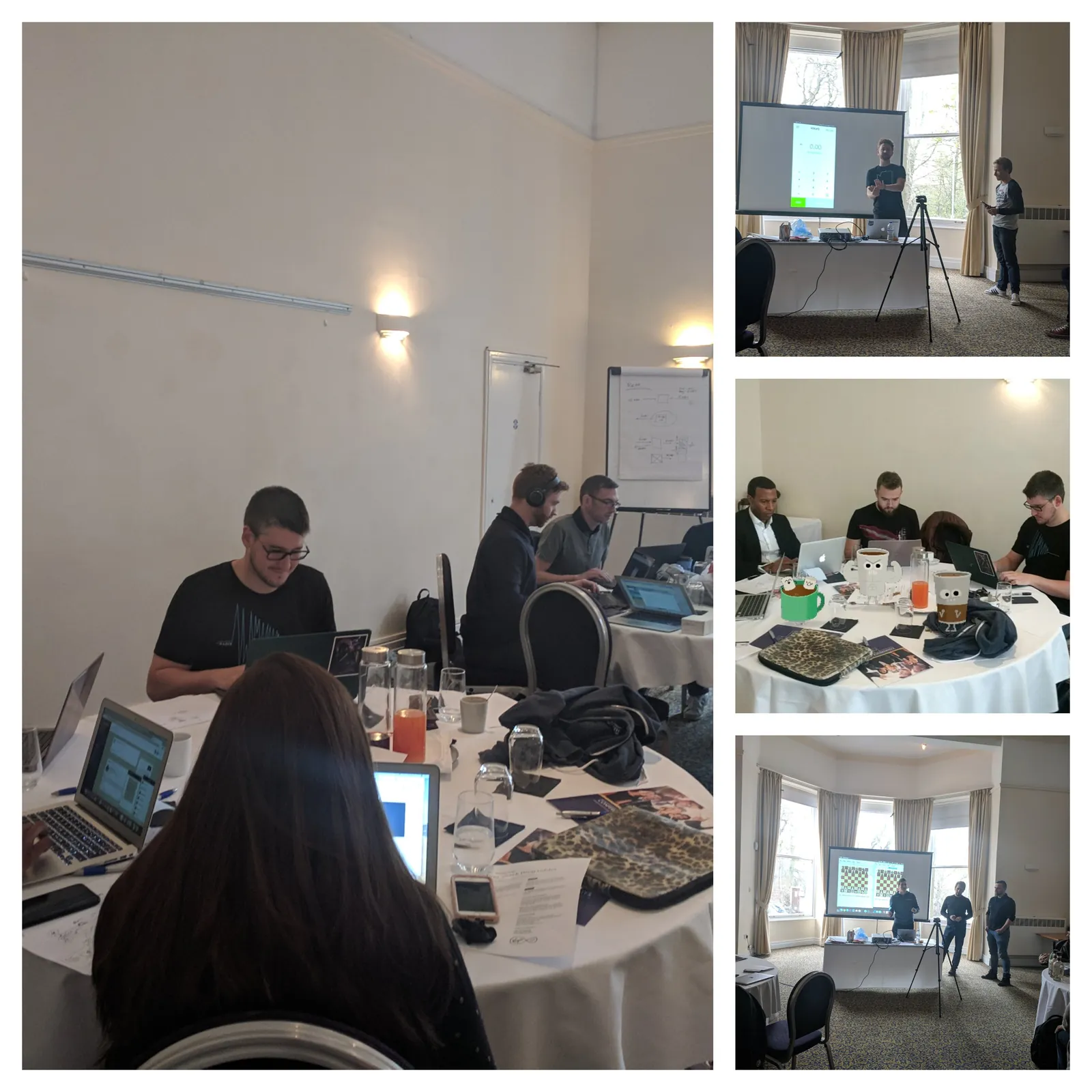

The Radix Team Hackathon was the first internal hackathon organised by RDX Works (then Radix DLT). It was held during the first week of April 2019, when the team gathered in the Peak District of northern England for its quarterly planning week and set aside one full day to build on the ledger, with project presentations and a team vote the following morning.
Format
Staff were split into six teams, each deliberately balanced with both technical and non-technical members so that the competition turned on ideas and execution rather than raw engineering firepower. Each team had 24 hours to design, build and demo a working prototype on the pre-Babylon Radix ledger, and several worked into the night to have something to show; the following morning was given over to presentations, questions and the vote.
Projects
The six prototypes spanned payments, identity, tooling and games. Three of them were later given their own write-up on the Radix blog; the descriptions below draw on those where they exist.
POS Card System
A point-of-sale and loyalty concept, which the announcement called a community favourite. The pitch was a single card or app combining credit, charge and loyalty functions, settling almost instantly and at minimal fees, with the cardholder rather than a payment processor holding the record of their own spending. RDX Works described what was built in a day as "quite staggering" and promised a dedicated post and the code; neither appears in the site's blog index today.
DecentraSign
Document signing and verification anchored to the ledger – a decentralised counterpart to DocuSign, built by a four-person team over one working day. Signing a document meant committing its cryptographic hash and a ledger timestamp, so that who signed what, and exactly when, could be proved without a central e-signature provider, and the signature could not be forged or backdated afterwards. The team demonstrated sending and verifying document hashes between two people. It received the first of the follow-up posts, "Timestamping on Radix – The DecentraSign Experiment" (2 May 2019).
Radix Universe Visualizer
A real-time browser view of network activity, written in JavaScript against the Radix JavaScript client library by two team members – one of whom had written that library. The design brief was to show atoms – the unit of ledger state before Olympia – moving across the network as they were stored, with sound effects layered over the graphics; the authors describe discarding more ambitious spherical-display and VR versions for want of the hardware, and settling on the metaphor of a giant pinball table with atoms rattling between the nodes. Its limitation was the network itself: with few nodes running at the time there was little to draw. Written up as "Radix Universe Visualizer" (6 June 2019).
Chess on the Ledger
The goal was to test how far application-level rules could be pushed onto the ledger itself, so that every node could act as a chess service and no third party was needed to referee a game. The team implemented the rules as ledger logic in the pre-Babylon application stack: two new Particles, one for the board and one for a move, evaluated by the Constraint Machine. A player moved by consuming the last board particle and submitting a new board state alongside their signed move, which the ledger then checked for legality against the referenced board – enforcing per-piece movement (pawns one square, bishops diagonally, knights in their L-shape), white to move first, no two consecutive moves by the same player, and no taking a move back once made. Because the board lived on the ledger rather than in a session, players could abandon a game and return to it later with the state preserved exactly, and anyone could watch (announcement). Written up as "Building Decentralized Chess On The Radix Ledger" (30 May 2019). Three years later the same idea was rebuilt from scratch at FooHack, this time in Scrypto, where each player's identity is a badge resource held in their wallet, which the 2019 build had no resource model to do.
Radix Planner
Immutable polls and surveys on the ledger, with the parameters of a vote fixed at creation so that a result could not be quietly re-scoped after the fact. The team also sketched it as an upvoted notice board – a company bulletin, a way of tracking wagers, a general consensus-gathering tool.
Command Line Interface – winner
Another way to talk to the ledger: check the balances and messages of a given address, and send both tokens and messages. It won the most votes of any hack, on the strength of a live demonstration of an automated payment chain – the worked example was a wallet instructed to forward 10% of every incoming payment to a savings address, so that a £10 payment moved £1 across without any further action by the owner. RDX Works pointed at charitable giving and automated distribution for trading syndicates as the obvious extensions.
RDX Works framed the day as evidence that building on Radix would be straightforward – a thesis later carried into public developer events such as the Scrypto Developer Event, the Scrypto DeFi Challenge, and the DApp in a Day university workshops.
The follow-up trail
The announcement post promised, six times over, that the code and a dedicated write-up for each project would follow "in the coming weeks". Three arrived, between two and seven weeks later: DecentraSign on 2 May 2019, Chess on the Ledger on 30 May, and the Universe Visualizer on 6 June. All three remain published. The Wayback Machine’s index of radixdlt.com blog addresses, read on 18 October 2026, holds none for the POS card system or the Radix Planner. The winning CLI may have had one: the old blog carried a post at /post/introducing-the-radix-command-line-interface-cli-based-on-the-unix-tools-philosophy, which by November 2020 redirected to the write-up of Radix’s 2018 hackathon in Lithuania and has returned 404 since 2022. The archive keeps no copy of its text, so whether it described the hackathon build cannot be checked (captures).
The code fared worse. Only one of the three posts named a repository, github.com/radixdlt/DecentraSign, and it returns 404 today. The prototypes were built on the atom-and-particle ledger that Olympia and then Babylon replaced, so none of them would run against the network as it now stands; what survives is the write-ups.